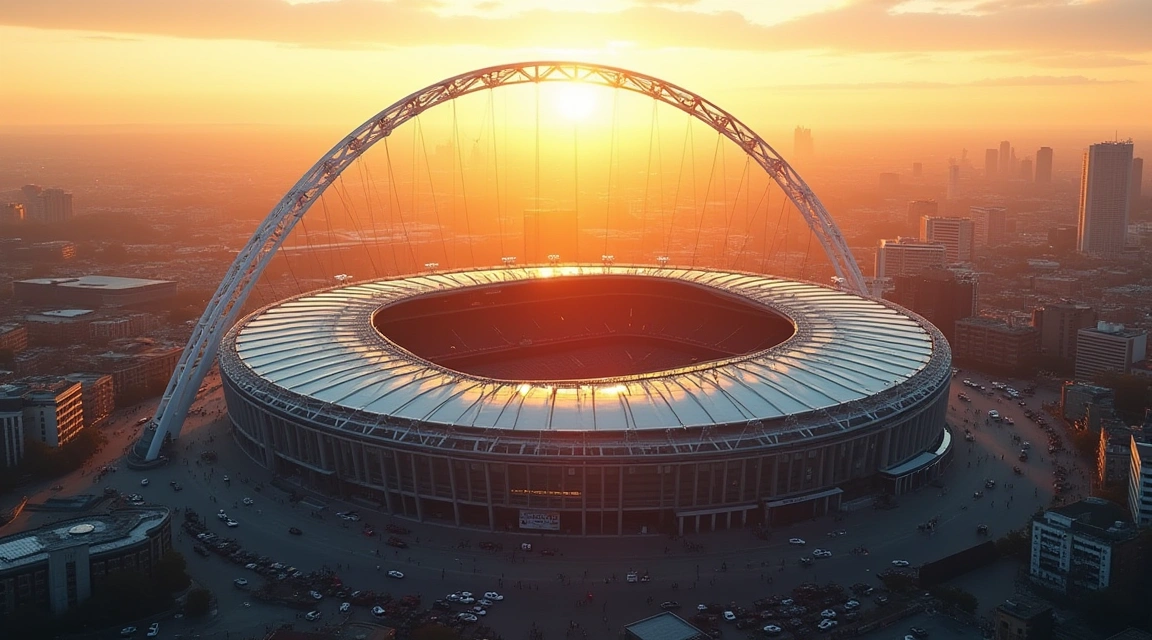
There is no stadium in the world quite like Wembley. Rising majestically above the north-west London skyline, its iconic arch visible for miles around, Wembley Stadium is more than just a sporting venue — it is the spiritual home of English football. With a capacity of 90,000, it stands as the largest football stadium in the United Kingdom and one of the most prestigious arenas on the planet. From World Cup finals to FA Cup showpieces, from international friendlies to play-off deciders, Wembley has hosted them all, and its place in the hearts of English football supporters is unassailable.
The Original Wembley: The Twin Towers Era
The original Wembley Stadium, known officially as the Empire Stadium, was built in just 300 days at a cost of £750,000 and opened in 1923. Its famous twin towers became one of the most recognisable landmarks in world sport, and for 80 years the stadium served as the beating heart of English football. The very first event held there was the 1923 FA Cup Final between Bolton Wanderers and West Ham United — the so-called “White Horse Final” — when an estimated 200,000 supporters descended on the stadium, far exceeding its official capacity of 127,000. A single white police horse, named Billy, became the enduring image of the day as mounted officers attempted to clear the pitch.
But it was on 30 July 1966 that Wembley truly cemented its place in sporting history. England’s 4-2 victory over West Germany in the World Cup Final remains the defining moment of English football. Geoff Hurst’s hat-trick, the debate over whether his second goal crossed the line, and Kenneth Wolstenholme’s immortal commentary — “Some people are on the pitch… they think it’s all over… it is now!” — are woven into the fabric of the nation’s identity. For those who were there, and for the millions who watched on television, it was a day that transcended sport.
Memorable Moments Under the Arch
The old stadium played host to countless other unforgettable occasions. Paul Gascoigne’s thunderous free kick against Arsenal in the 1991 FA Cup semi-final is still talked about with reverence — a moment of pure genius from one of England’s most talented and troubled footballers. The Live Aid concert in 1985 brought the world’s biggest musicians to the Wembley turf, while the 1996 European Championship saw the stadium rocking to the strains of “Three Lions” as England reached the semi-finals on home soil. Gareth Southgate’s missed penalty against Germany in that tournament’s last four would haunt him for decades, until he returned as England manager to write new chapters at the rebuilt ground.
The original Wembley closed its doors in October 2000, with the final match being a World Cup qualifier against Germany. Dietmar Hamann’s free kick gave the visitors a 1-0 win, and Kevin Keegan resigned as England manager in the toilets afterwards. It was a fittingly dramatic end to the old ground’s reign. Demolition began in 2003, and the twin towers — despite a passionate campaign to save them — were brought down to make way for the new stadium.
The New Wembley
The new Wembley Stadium, designed by Foster + Partners and built by Multiplex at a cost of approximately £798 million, opened in March 2007. The twin towers were replaced by a stunning 133-metre steel arch, which supports the entire roof structure and has become just as iconic as its predecessors. The stadium’s 90,000 capacity makes it the second-largest stadium in Europe, behind only Camp Nou in Barcelona, and it boasts 2,618 toilets — more than any other venue in the world.
During the 2012 London Olympics, Wembley hosted the football tournament, welcoming the world’s finest players and creating yet more memories on its hallowed turf. The atmosphere during the Olympic matches was electric, with capacity crowds adding to the sense of occasion. More recently, the stadium hosted multiple matches during Euro 2020 (played in 2021), including the semi-finals and the final between England and Italy — a night of heartbreak as England fell on penalties but one that demonstrated Wembley’s enduring capacity to stage the biggest moments in football.
Getting to Wembley
Wembley is exceptionally well connected by public transport. Wembley Park station on the Metropolitan and Jubilee lines is just a five-minute walk from the stadium, while Wembley Stadium railway station offers direct services from Marylebone. On match days, the famous Wembley Way — now officially called Olympic Way — fills with supporters making the walk from the station to the ground, a pilgrimage that has become a ritual for football fans across the country. Driving is possible but not recommended on event days, as parking is extremely limited and traffic congestion can be severe.
Whether you are visiting for an England international, the FA Cup Final, the League Cup Final, or the play-off finals that decide promotion to the Premier League, a trip to Wembley is an experience every football supporter should have at least once. The stadium continues to evolve and improve, with ongoing enhancements to its facilities and technology ensuring that it remains at the cutting edge of sporting venues. Wembley is not just a stadium — it is a monument to the game itself, a place where history has been made and where history will continue to be written for generations to come.
Useful Resources

 Arsenal
 Man City
 Man United
 Aston Villa
 Liverpool
 Bournemouth
 Sunderland
 Brighton Hove
 Brentford
 Chelsea