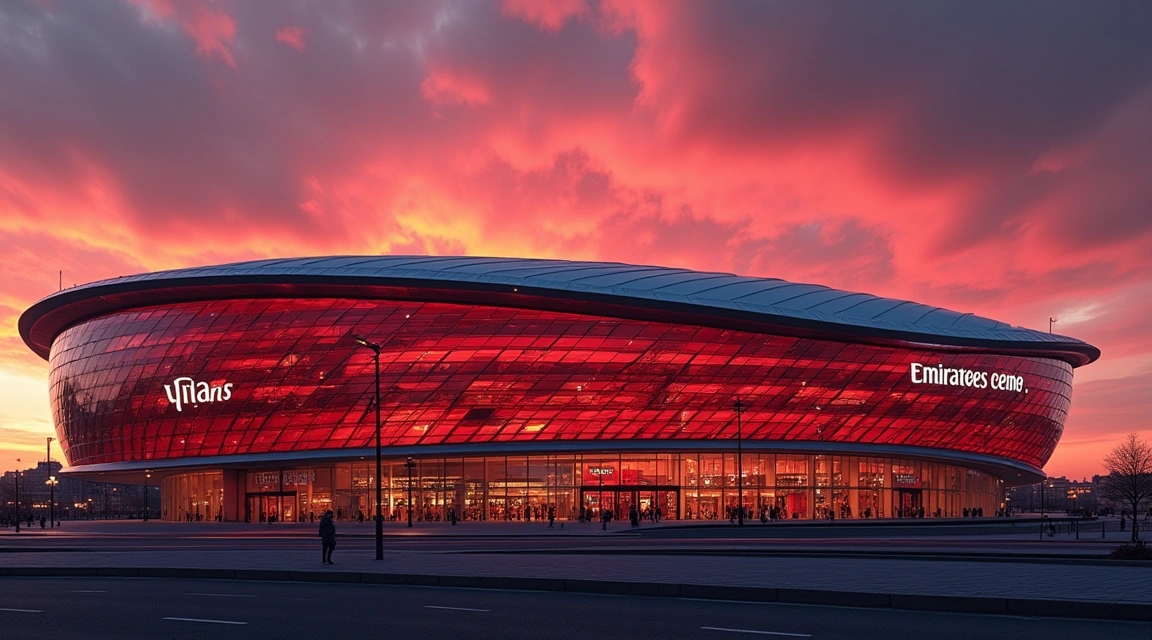
When Arsenal left Highbury in 2006, they were not simply moving to a new ground — they were making a leap of faith. The club that had called the Art Deco splendour of Highbury home for 93 years was relocating to a gleaming, purpose-built arena just 500 metres down the road in Ashburton Grove. Twenty years on, the Emirates Stadium has established itself as one of the finest football venues in Europe, a 60,704-capacity fortress that perfectly reflects the ambition and modernity of one of England’s greatest clubs.
Leaving Highbury Behind
The decision to leave Highbury was driven by necessity as much as ambition. The old ground, with its famous marble halls, the Clock End, and the North Bank, had a capacity of just 38,419 following its conversion to an all-seater stadium in the early 1990s. While Highbury was intimate and atmospheric — opponents genuinely feared playing there — it was commercially limiting. Arsenal could not compete financially with the revenues generated by Manchester United’s 67,000-capacity Old Trafford, and the restricted Islington site made expansion impossible. Arsène Wenger, the visionary French manager who had transformed Arsenal’s playing style, was a driving force behind the move, understanding that a larger stadium was essential for the club to compete at the highest level in the long term.
The Emirates Stadium project cost approximately £390 million and required significant financial sacrifice. Arsenal entered into a naming rights deal with Emirates airline worth £100 million over 15 years, and the financial constraints of the stadium build meant that Wenger was forced to operate with a reduced transfer budget for several seasons. The “banter era,” as some supporters ruefully refer to the years between 2006 and 2020, saw Arsenal fall behind their rivals in terms of on-pitch success. Yet the stadium itself was a masterpiece of modern design, created by architects HOK Sport (now Populous), with sweeping curves, excellent sightlines from every seat, and state-of-the-art facilities throughout.
The Stadium Today
The Emirates has matured into a ground that combines its ultra-modern facilities with a growing sense of identity and history. The four external bridges that connect the upper tiers to the concourse are named after club legends — the Ken Friar Bridge, the Dennis Bergkamp Bridge, the Thierry Henry Bridge, and the Herbert Chapman Bridge — while statues of Henry, Tony Adams, and Bergkamp stand proudly outside the ground. Inside, the stadium’s bowl design creates an amphitheatre effect, with the steep upper tier bringing supporters close to the action and generating a wall of noise on the biggest occasions.
- Capacity: 60,704 (all-seated)
- Opened: 22 July 2006
- Cost: Approximately £390 million
- Pitch dimensions: 105m × 68m
- Nearest tube station: Arsenal (Piccadilly line) or Holloway Road
Arsène Wenger’s Enduring Legacy
It is impossible to discuss the Emirates Stadium without acknowledging the towering contribution of Arsène Wenger. The Frenchman managed Arsenal for 22 years, from 1996 to 2018, and his fingerprints are on every aspect of the club’s modern identity. Wenger oversaw the transition from Highbury to the Emirates, sacrificing short-term success to ensure the club’s long-term financial stability. His commitment to beautiful, passing football — epitomised by the Invincibles season of 2003-04, when Arsenal went the entire Premier League campaign unbeaten — set a standard that continues to influence the club’s philosophy to this day.
Under Mikel Arteta, who took charge in December 2019, the Emirates has found its voice again. The transformation of Arsenal into genuine Premier League title contenders has reignited the atmosphere inside the ground, particularly on European nights and in the big domestic fixtures. The North Bank end, home to Arsenal’s most vocal supporters, has become a cauldron of noise, with the “North Bank, North Bank, North Bank” chant echoing around the stadium and sending shivers down the spines of visiting teams. The contrast with the sometimes sterile atmosphere of the stadium’s early years is stark and welcome.
Big Match Days at the Emirates
On the biggest match days, the Emirates is genuinely electric. The build-up begins hours before kick-off, as supporters stream out of Arsenal and Holloway Road tube stations and fill the concourses and surrounding streets. The Armoury, the club’s official store, buzzes with activity, while the scent of food from the various catering outlets drifts through the air. Inside the ground, the pre-match light show — introduced in recent seasons — creates a dramatic spectacle, with the stadium bathed in red and white before the players emerge from the tunnel. When 60,000 supporters rise as one to welcome their team, the Emirates proves that modern stadiums need not lack soul or atmosphere. Arsenal’s fortress in Ashburton Grove has truly come of age.
Useful Resources

 Arsenal
 Man City
 Man United
 Aston Villa
 Liverpool
 Bournemouth
 Sunderland
 Brighton Hove
 Brentford
 Chelsea