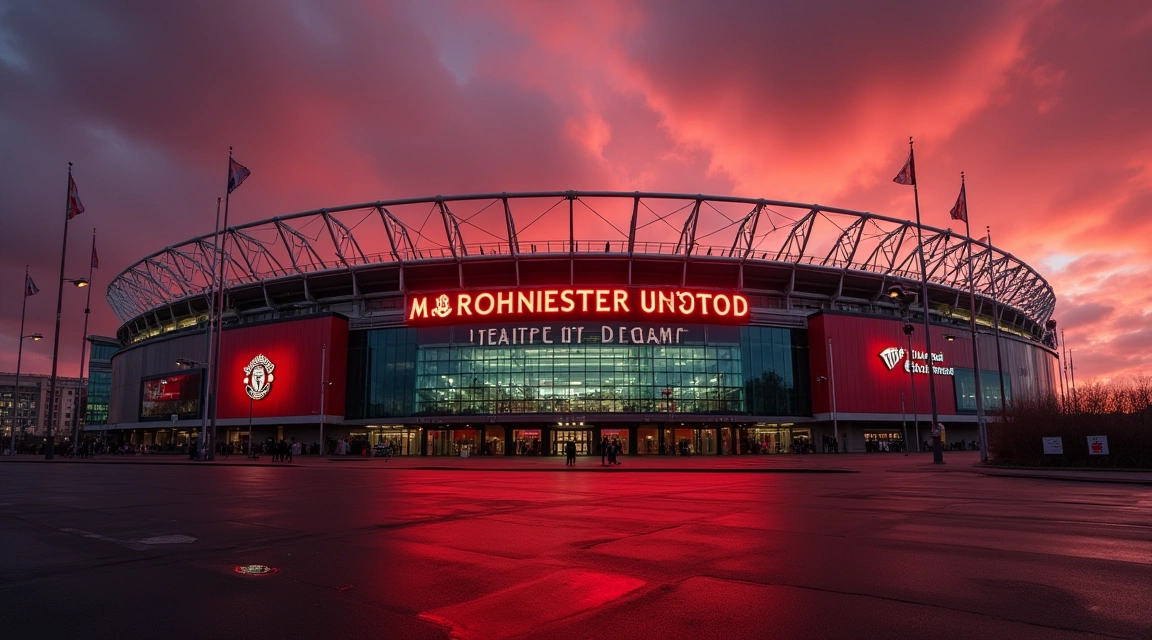
Old Trafford is more than a football stadium. For over a century, it has stood as a cathedral of the beautiful game, a place where legends have been forged and where the spirit of Manchester United — one of the most storied clubs in world football — resides in every brick, every beam, and every blade of grass. With a current capacity of 74,310, it is the largest club football ground in the United Kingdom, and its nickname — the Theatre of Dreams, bestowed upon it by Sir Bobby Charlton — perfectly captures the magic that has unfolded within its walls since 1910.
A History Steeped in Greatness
Old Trafford was designed by the renowned Scottish architect Archibald Leitch and opened on 19 February 1910, when Manchester United hosted Liverpool in a First Division match. The original ground had a capacity of around 80,000, making it one of the largest and most impressive stadiums in the country from the very beginning. However, tragedy struck during the Second World War when the stadium was heavily damaged by German bombing raids in March 1941. The destruction was so severe that United were forced to share Maine Road with Manchester City for several years until Old Trafford was rebuilt and reopened in 1949.
The man who transformed both the stadium and the club was Sir Matt Busby. Appointed manager in 1945, Busby built successive teams of breathtaking quality, culminating in the famous Busby Babes of the 1950s. The Munich air disaster of February 1958, which claimed the lives of eight players and fifteen others, is commemorated at Old Trafford with the Munich Memorial Clock and a plaque that serves as a poignant reminder of the tragedy. That Busby survived his injuries and went on to rebuild the team, eventually winning the European Cup at Wembley in 1968, is one of the most remarkable stories in all of sport.
The Stretford End and the Matchday Experience
No discussion of Old Trafford is complete without mentioning the Stretford End. This is the heart and soul of the stadium’s atmosphere, the stand where United’s most passionate and vocal supporters gather to drive their team forward. Originally a vast, open terrace, the Stretford End was redeveloped into a two-tiered seated stand in the 1990s, but its reputation as one of the most intimidating places in English football has endured. On European nights, when the floodlights illuminate the pitch and the crowd rises to greet the Champions League anthem, Old Trafford is a truly special place to watch football.
The stadium has been modernised extensively over the decades, with the most significant redevelopment occurring in the 1990s and early 2000s under Sir Alex Ferguson’s reign. The addition of second tiers to the East, West, and North stands increased the capacity to its current figure, and the quadrants added in 2006 brought further improvements. The Sir Alex Ferguson Stand, renamed in his honour in 2011, dominates one side of the ground, while the Sir Bobby Charlton Stand — renamed in 2016 to honour the Munich survivor and European Cup winner — faces it on the other.
Iconic Matches at the Theatre of Dreams
Old Trafford has been the stage for some of the most dramatic moments in football history. The 1999 Treble season, when Sir Alex Ferguson’s side won the Premier League, FA Cup, and Champions League, saw several unforgettable matches at the ground. The semi-final second leg against Juventus in the Champions League, when United overturned a two-goal deficit to win 3-2 and reach the final in Barcelona, is frequently cited as one of the greatest European nights in the stadium’s history. Roy Keane’s commanding performance that evening, knowing he would miss the final through suspension, remains one of the most heroic individual displays the ground has ever witnessed.
- Capacity: 74,310 (all-seated)
- Opened: 19 February 1910
- Record attendance: 76,962 (vs Wolverhampton Wanderers, 1939)
- Pitch dimensions: 105m × 68m
The Future: A New Old Trafford?
In recent years, the condition of Old Trafford has become a source of concern and debate among supporters. Ageing infrastructure, including well-publicised issues with leaking roofs and outdated facilities, has led to growing calls for significant investment. Under the club’s ownership by INEOS and Sir Jim Ratcliffe, ambitious plans have been drawn up for the redevelopment of Old Trafford. The most dramatic proposal involves the construction of an entirely new 100,000-capacity stadium on land adjacent to the current site, which would make it the largest club ground in Europe. Alternative plans include a comprehensive renovation of the existing structure, modernising the facilities while preserving the heritage and character that make Old Trafford so beloved.
Whatever form the redevelopment ultimately takes, Old Trafford’s place in football history is already assured. It has hosted World Cup matches, European Championship games, Champions League finals, and countless domestic showpieces. It has seen the genius of Best, Law, and Charlton; the brilliance of Cantona, Beckham, and Giggs; and the modern excellence of Rooney, Ronaldo, and Fernandes. The Theatre of Dreams may be evolving, but the dream itself — of attacking, entertaining football played in front of a passionate crowd — will endure for as long as the stadium stands.
Useful Resources
 Bournemouth
 Arsenal
 Aston Villa
 Brentford
 Brighton Hove
 Chelsea
 Coventry City
 Crystal Palace
 Everton
 Fulham